Showing posts with label uk. Show all posts

Monday, February 03, 2014

Art & I & Art

Or, why do I always have this internal struggle?


This year’s ARCO logo. 2014.

AOG, Madrid

This past weekend Madrid held its international art fair: ARCO. This art fair has been an annual event for me ever since I moved to Spain.

I have gone every year since then to every single one, and every year I walk away thinking to myself, ‘Why the Hell don’t I start doing that?’.

By “that” I am referring to art, in whichever way you wish to define it.
And art and I have had a very tormented relationship from the very start. And it goes on today.

There are many reasons why I don’t live and work as an artist.

And I dislike every single one of them, yet, that has always been, to use a well-worn euphemism, the story of my life.

The cruel beginnings…

When I was a young kid I asked my mother to let me take drawing classes.
I remember going to my first-ever drawing lesson.

I remember the anticipation, the nerves I felt then. The joy inside of me as I anticipated what was to happen.

As a kid, nothing made happier than drawing. I loved it.

I remember that I read somewhere that there was an art academy near where we lived. Maybe it was just a poster, or an ad in a magazine. And I remember pestering my mother to let me go to drawing classes.

After my mother tired of hearing me, she allowed for this to happen. And I was over the moon.

It was a complete fiasco.

We went to the academy in question and I saw several tables with children pouring over their work. I was very excited because I’d soon be learning what they were learning, and I’d be working alongside them. It was going to be my first extracurricular activity ever.

Madame Mère (as I like to call her theses days) and I were shown around the academy, the director explaining to her what the children were doing at that particular moment.

And what were the children drawing?

They, all of them, were drawing a picture of a mountain top and the moon.

Circle and triangle. Basic.

And it seems like that is all they had been drawing and all that they were going to draw for a long time.

My mother asked about this, and she was told, again, that until the children learned how to do that well, that was all they were going to do.

Only that picture?

Yes, only that picture.

My mother thanked the director for her time and said she would think about it.

She didn’t drop me off at the academy that day, as I had been expecting to happen; she didn’t say she’d be picking me up later. 

She didn’t do any of the things I thought were going to happen.

instagram: @tony4sure

Once outside, or in the car, or the elevator, or wherever it was that we were at when we were alone, I asked her about what had just happened. 

Why wasn’t I being dropped off? What was happening?

I don’t remember her exact words but it was something along the lines of ‘I don’t think they have a very good idea about how to teach drawing to a child’.

She really didn’t like the thought of me doing just one painting over and over.

I, on the other hand, would have killed at the chance to do just that. But it was not to be. She had seen a problem with the academy and dismissed it. And for some reason, she never bothered to find another one.

Now it would be unfair to say she didn’t encourage my sister and I to express our creative side.

Although I never went to art class, Madame Mère did spend hundreds of dollars, if not thousands, paying for art supplies throughout our entire childhood.
Instagram: @tony4sure

She paid for ballet school, piano lessons, acting lessons.

Only as an adult, when I went to live in London, did I take a photography lesson.

And ever since then, photography has been with me as a sort of surrogate for drawing.

But I still draw. Badly. Awkwardly. Furtively. But passionately.

With time, my drawings became more about designing things.

When we first came to Europe in 1988, for some strange reason, I decided I would start drawing buildings.

Ever the frustrated architect, I was content to draw skyscrapers, cut out the shapes, as though they were paper dolls, and ‘assemble’ them.

I had already started designing cars a couple of years before. And shoes. And clothes. And furniture. But I never trusted my drawing skills. And I never took it seriously. So I never did anything with it. I just drew. I just draw.

But I take art seriously. I take my photography seriously. And my writing. And my acting. And I recently joined a choir, and I take that seriously too. Just as I took music seriously when I had a magnificent keyboard I never learned how to play well. I am also a frustrated composer.

But I am a great reader. And all of those years I read about art. And then I did a BA in Art History (and History with a philosophy minor). 

And I combined that degree with photography, and my love of all the arts. And you can see the results online. Follow me on instagram for the more immediate images: @tony4sure.

Being an artist.

For years, as one does, I never thought of myself as an artist. I was just doing what everyone else did -so I believed.

I used to think that since I liked art, so did everyone else.

Since I could draw, so could everyone else.

Since I could dance, and sing, and act, and all the rest, so could everyone else.

Realizing that was just not the case took me years.

Not so much a rude awakening as a realization: not everyone is an artist.

But was I an artist? Or was I just artistic?

I was an actor, a singer, a writer, even a half-assed musical composer when sitting at the keyboard, but an artist?

It took a while before the dots connected.

The proper thank you.

I have to thank London for telling me what I was. For opening my eyes. For slapping me in the face with what was there.

You see, London, like any major metropolitan area, attracts its fair share of talented people.

And talented people are excellent at recognizing talent in others, and extremely adept at letting you know when it is not there. Cruel in fact.

And it was a group of those people who told me what I had never been able to see myself: that I was an Artist

That I had always been one.

But it took a while before I accepted this about myself.

Weird, right?

Instagram: @tony4sure
 I was informed that I didn’t take photographs just because I pointed the camera and pressed the shutter. I had compositions. Angles. I was producing images, not just photographs.

I could act, and embody a character. I could express feelings through movement as a dancer. I could write poetry, and prose. I was a producer of art, not just a consumer.

And I should have gone to Art School. RADA, or Central St Martin’s, or the Royal Academy of Art. But I didn’t.

Why?

Because I was not an artist in my head. Art was something everyone did. Hence, I undervalued it greatly.

But I wanted, still want, to learn. And to produce art.

As a designer, I wanted to learn about CAD. Not programming, just using this wonderful program to make my car designs look real. Or professional. Or just better.

But couldn’t. And didn’t.

So these days, I channel my impulses as best I can.
Instagram: @tony4sure

And most of the time I am happy with the exercise (if not necessarily the actual output).

But now and again, I go to an art gallery, or a museum, or some exhibition somewhere, and I kick myself for not being an artist.

For not working as one.

Or, perhaps, what I am kicking myself about is really for not having been clever enough to convince a gallerist to buy my photographs, for not being a writer in print (though I am in print as a journalist).

For not getting that recognition which, as an actor, I do get when I perform with my improv colleagues.

For lacking that confidence and living with that internal struggle.

But, you know what? Perhaps it is the struggle which keeps me writing, and acting, and reading, and taking photographs, and all the rest.

Because being an artist is so many things…


Thursday, May 30, 2013

 Odd Economics

AOG, Madrid
I was last in London over Christmas and I hadn’t gone back until now, late May. 

My how the place has changed!

First of all, there’s the Shard. 

A tall pyramidal structure made of glass and which some are referring to as Mordor.

Although impressive from a distance, close-up it suffers from that thing that so often occurs in the UK: location, location, location. Or rather, a lack thereof.

It is not in a good neighborhood and, for a building intent on promoting finance, it is not in the City.

I got pretty close to it from London Bridge’s station’s platform 6, which takes you straight to Charing Cross.

From there, you get a glimpse of the glass behemoth, and you can't help but be taken aback by the fact that the thing looks a) unfinished, and b) empty.

As is the case with many European cities today, there is an overabundance of empty office space, and London is not the exception.

According to FT,  “In a survey of the industry by CBRE, the world’s largest property fund by assets, three-quarters of banks with a presence in London said that they were planning to cut the amount of office space they used.”

And according to The Telegraph, in 2009: "Approximately 11.9% of City offices are vacant – equivalent to 10 large city towers – up by a tenth already in 2009 and more than double the 5.2pc prior to the onset of the credit crisis in 2007, as increasing numbers of businesses collapse or downsize.”

So it would appear that another glass tower is not really what London needs. 

And yet, there is something amazing about tall buildings. 

The way they defy our human perspective and make us dream of the views we would see from them. Yes, there certainly is a dreamy aspect to tall buildings.

Second of all, my trip to London also informed me of the fact that the city is living trough a construction boom. 

Around the Greenwich area, any empty lot has been turned over to a building company which will gladly erect one of those boring looking, yet ever so trendy, housing plots with pseudo-modern architecture (which, in case you are wondering, just means pricey properties with small rooms and hardly any storage space).

A friend of ours who lives in the area said he was appalled at all the construction and mentioned how these days, most of those properties are being snapped up by wealthy foreign nationals, who will be in the UK for, maybe, a week per year, and city types who commute into and out of Canary Wharf, but never set foot in the area.

And according to Londonist magazine, this boom is only helping to make property even more expensive: “Average asking prices in London have gone past the £500,000 mark for the first time, and Camden has joined Westminster and Kensington and Chelsea as a borough where average prices are over £1m. 

We’ve also noticed a little flurry of articles pointing out the extent of foreign interest in high-end property. 

The New Statesman points out today that only 45% of buyers in central London are UK nationals; Russians and Middle Eastern citizens are those who seem to find the posh bits of the capital most tempting. 

The New York Times recently looked at the effect on local businesses of increasing numbers of owners using their London homes as temporary stop-off points. 

This phenomenon is exemplified in One Hyde Park, where Vanity Fair found that just 17 of the 76 apartments sold are registered as primary residences, and seems to be practically empty.”

I wonder about how healthy this is for a country.

On the other hand…

During my stay, I also met with a couple of friends. They corroborated this idea about London’s average housing prices being too steep, especially for a country where average wages are around £26,000. 

Who in London can afford half a million for a place to live?

Some can, no doubt, but most people, most Londoners, cannot. 

On that subject, we talked about recent studies which mentioned how, it is now becoming very obvious, that all the wealth being created in the City of London is not filtering downwards. 

Yes, the City of London creates jobs, that is, it creates employment for the people who serve the people who work -mostly in finance- in the City.

However, all that wealth being amassed there is not percolating down to the rest of the country.

In fact, a large proportion of it is not even taxable, thanks to the UK’s myriad of legal and financial loopholes and tax havens (Gibraltar, Channel Islands, etc etc etc).

London might be one of the planet's financial capitals, but if you are living outside of London, in a council estate, how is that benefitting you and your family?

None of this is illegal, of course (because politicians pass the laws which benefit their friends), but is it ethical?

Desirable?

A really bad precedent...

In Spain, meanwhile, people often like to bring up the example of Mr. Álvarez Cascos, PM's Aznar's Development Minister who, a few years ago, when asked why property in Spain was so expensive, replied "if it is expensive it is because Spaniards can afford it".


What he was trying to say was that he was proud that property was expensive because it meant the Spanish were doing well.

This was before the Conservative party lost the 2004 elections and Spain was hit by an economic crisis from which the country has yet to emerge.

Unfortunately for Mr. Álvarez Cascos, as well as for Mr. Cameron in the UK, most citizens were not so rich that they could afford a property.

In Spain this meant that banks took advantage of people, prices were inflated, and the property boom turned into a bubble which burst.

It meant that property for lower middle class, and middle class families, suddenly went up in price, and many people, as is the case in the UK, were priced out of the property market.

It means that, given Spain's anachronistic mortgage and property laws, you may turn your property's keys to the bank, and it may sell it, but you will still own the bank whatever was left on your mortgage.

It means that many people are being made homeless even today in Spain, while the Government looks on.

It means that many immigrants left the country, the home they bought, and their debt, in Spain and went back to where they came from.

All of this points to Spain's failure, especially since Madrid, unlike London, is not so international a city that many Russian or Middle Eastern investors are willing to pay half a million Pounds (or the equivalent in Euros) on average for the privilege of having a property there (although they will pay this much for property on the Costa del Sol, but that's a different story).

In the UK, where this has happened in the past, what is happening is that people are slowly being forced to move elsewhere. In many instances outside of London.

It is not a crazy idea to suggest that in the not-too-distant-future, London will be a half empty city where a lot of rich people don't live, and a lot of crime takes place.

Is this really what the British Government would like?

And before anyone says 'but what can they do', let me just say, if you are the Government and you don't know what to do, then you shouldn't be the Government.


Friday, July 01, 2011

The moment I felt most American

AOG, Madrid

On election day 1988 my mother, my sister and I were on a Jumbo Jet heading for Europe. 

We arrived in Madrid and within less than an hour we were on a train heading for the region of Extremadura, on the border with Portugal. 

My thoughts on that long journey (it was about an 8 hour train journey then to add to the transatlantic flight) centered around what our new lives would be like in this continent. I remember being told at the time that Spain only had 2 television channels. 

This might seem ridiculous to you, but I had grown up with cable, and two channels seemed insufficient to me. And third-world like. And I wasn't happy about it.

I remember stepping off the train and looking over the tracks to my right. A beautiful hill and forest scene with sheep peacefully standing there, hardly moving. To my left, the future. 

We had gone to Extremadura because one of my mother’s great aunts lived there with her Italian husband, who came to pick us up at the train station. My parents were separated now and would divorce a few years later, and this was the only close family we had at the time. 

The car which picked us up at the station was a white Ford Escort. I remember thinking then “ok, I know this model, everything is going to be ok”. 
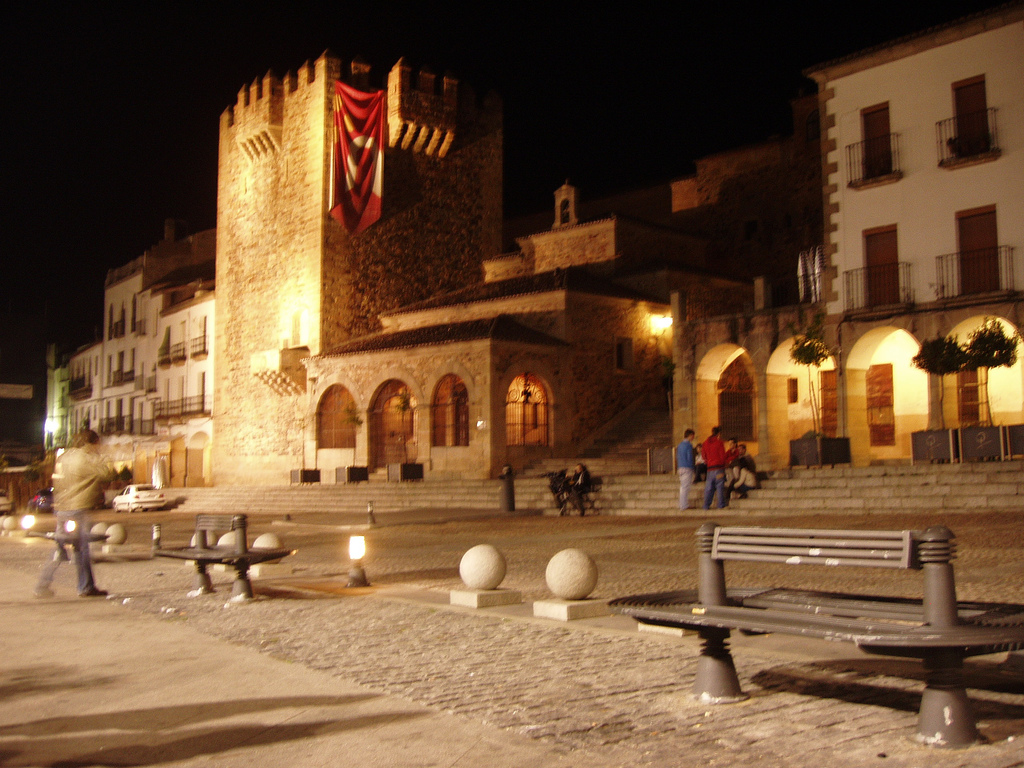
View of the city of Caceres
 A couple of days later, my sister and I went into town on our own. I clearly recall my thoughts when I saw this very modern looking parking meter with a digital screen right next to a XVII century Baroque palace with medieval elements attached to it.

I immediately thought back to the meters in Houston where you had to stick a quarter and roll a handle to watch a little flag pop up telling you how much time you had left. 
 At that moment, America didn’t seem modern at all, especially when compared to this country which could allow things like Baroque palaces and modern digital machines to co-exist side by side. It was, I think, my first eye-opener.

A year after landing in Spain, we landed in London. Life was moving on.

I have to say that from the moment I set foot in Europe in 1988 I have felt American on a daily-basis. It is hard to explain, but it must be related to not really knowing what the deal is most of the time. To making a faux pas here and there, that you are not even aware that you are making. 

To looking at things and thinking, “my God what are they on about with this?”. 

To reacting to some situations in a manner different from expected by my friends and colleagues.

To not settling for tripe when tripe is being served (although I think this is more about me than about me being American; many Americans settle for tripe too easily).
I know I am different from most of the people who surround me and my life. I think differently.  I act differently. I react differently. I want different results. Better things in general.

And I'm glad I do. Just as I am glad that they think differently from me.

I have experienced hundreds of examples of this  cultural disparity since election day 1988.

But back to the original question.

In 1995 I went back to the US and stayed with a friend in Alabama. it was my first trip back since 1988.

Although everything was familiar I could see small cultural cracks here and there. I was no longer the same person who’d left the country 7 years before.

And the questions began to flood in. Some positive, some negative.

Why do people drive everywhere? Why don't they make more sidewalks? Why do they all eat so much processed food? Why are things national and not local? Why are there so many people who allow religion to rule their lives? Why all this racism and hate? Why are women's fashion and hair stuck in the 1980s?

I was feeling very much the European throughout. But then something happened.
 Shortly before I left, I went out one night in Birmingham and I met this guy who was very friendly.

I remember talking with him about things, his life and his future, and mine. He was about my age and had achieved quite a lot. He told me about his up and coming projects, dreams, and achievable goals. There it was once again. American positive thinking. Everything was possible.

I remember thinking during that conversation that I needed to get my butt in gear and be like my right-there-in-front-of-me peer.

I needed to complete my education, just like him, and start aiming for a good job, just like him, and aim for a better life, just like him.

He was talking to me in a language I completely understood. The cultural references were identical. The outlook was familiar and well trodden. The goals achievable. The future was bright, and it had an American glow about it.

I felt very American just then. That instant catapulted me back to the person I used to be just before that Pan Am flight touched down at Madrid Barajas Airport in 1988. The feeling stayed with me for a long time afterwards.

I returned to London.

Yes, the minute I got back to my flat in central London the questions started flowing, but in reverse.

Why is everything so expensive? Why is everyone so poor? Is this a police state? Why doesn’t anyone smile? What am I doing here?

It was a few years before I realized what I was doing there and before I could answer my  own questions.

I confess that these days, I am one of those people who feel very American in Europe, and very European whenever I go to the US. I can't help that. In fact, I rather like it. 

Monday, April 25, 2011

Royal Wedding 2011


AOG, London

I just spent the better part of my weekend traipsing all over London. I would like to say that you can't help but notice that there is a Royal Wedding in our midst….but I’d be lying.

Regent Street
London’s West End was, for once, not at all interested in Royalness. 
This may, and probably will, change by Friday. 
But if you walked around Oxford street, you’d be forgiven for thinking the wedding had been and gone. 
Until you turn into Regent Street that is. Once there, you do get a feeling of, not Royalness, but Britishness. Why? 
Only because they have Union Jacks flying from one side of the street to the other all the way from Oxford Circus to Picadilly Circus. But that’s about it. 
Here and there, some stores had either a union jack “motif” on their window, or something alluding to the happy couple. But little else.

Further afield the West End, for example on the train back to the airport, you could see some towns had one street with bunting and union jacks. But not much else.

However, this is not to say that the wedding is not having an impact on sales. Many shops (Ted Baker, Paperchase) have some sort of Union Jack/Royal regalia object or product for sale to commemorate the event.

As do the tourist stands which pepper all of the West End. You know, those places which entice you to purchase a mug with the portrait of the Queen or Prince Philip, or a postcard with some royal plastered on it, or any other "royal" kitsch paraphernalia.
 Or the ubiquitous Union Jack with a portrait of Kate and William. These are bestsellers they told me.

To be fair, most of the people I spoke with are happy they are getting married but not so happy about the financial state of their country. The wedding is reputed to be on the Queen’s bank account. That is to say, the British “people” are not paying for it. 
Except that not many people believe that and, of course, no one will even know the true cost of the affair.

However, officially, her majesty is paying as are Miss Middleton’s family –who, by the way, are millionaires (you didn’t think he was going to marry somebody poor did you?). 
Certainly the Royal family is paying for the dress and the receptions at Buckingham palace (where some food will be served but not as much as you think!*).

But what I think they are not paying for is the cost of policing the event, and the clean up afterwards.

As it is, London Police are inspecting manhole covers, drains, traffic lights, and lamp posts along the parade route. Overall, the security operation is expected to cost £20 million ($32.6 million).


However, it is worth saying that many people can’t help to look back to that other royal wedding, the fairy-tale one, when the heir to the British throne married a certain Lady Diana Spencer, mother of this year’s groom.
If you need your daily Royalty fix, look no further than this blog by the BBC.  
*A few years ago, the Palace uncovered an alarming statistic about guests attending the Queen's annual garden parties. Rather than just nibbling on one or two snacks, they were consuming, on average, 14 sandwiches, cakes, ice creams and scones (I mean, how dare they those plebs!). The palace has come up with an ingenious solution — they  have reduced the size of the treats on offer!


Monday, February 28, 2011

The King's Speech

AOG, London

I just saw the Oscar ceremony, and I have to say I'm slightly disappointed by the election of The King's Speech as the winning movie. As the best movie of the year. 

I had a hard time picturing this film as a contender for the crown in the first place, and given the competition, it is surprising that it won.

I saw it a few weeks ago and I remember leaving the movie theater feeling a bit... well, a bit like nothing had really happened. 

No great climax, no interesting insights, no great idea. 

The story is simple enough, the next in line to the  British throne, the future George VI,  has a speech impediment and an Australian speech therapist (played by  the great Geoffrey Rush) helps him to speak well. 

There you go, that is the whole movie right there. 

You'd think that being a British film (and this is the reason why it won, because in the US, anything British and Royal at the same time is a surefire winner) they could have done a bit more work on the plot. 

But no, in fact, poor Mr. Firth, who is a very good actor, and now one with an Oscar under his belt (yes, though we all know the Oscar is really for his performance last year in A Single Man) pretty much carries the weight of the whole movie on his shoulders.

Helena Bonham-Carter, as the future Queen Mother, is good at, well, at being Helena Bonham-Carter playing a royal person, not at actually playing the Queen Elizabeth, the Queen Mother herself. I saw a similar performance of hers in Tim Burton's Alice in Wonderland a few months ago. Less manic, but just as "royal".

All this time, when people have asked me about the movie, all I have been able to muster has been that it is a "nothing film". And that is all it is. 

A pretty (though it could have been more spectacular), simple (though it could have been slightly more complicated), very well acted movie based on a few stories concerning King George VI, himself a very interesting character (the last Emperor of India, the last King of Ireland  &c.). 

And it is odd that no more was made of his life, that all that mattered was that one speech problem and that all else was superseded to it. And believe me, there was more. Of the relationship between  George VI and his brother, King Edward VIII. 

Of the strained relationship with Wallis Simpson and what she meant for the future of the monarchy -sadly played by Eve Best, a British actress playing the infamous American divorcée -credited for coining the famous boutade "You can never be too rich or to thin". 

To say nothing of the awful performance delivered by Claire Bloom as Queen Mary. Yes, a miscast. Or perhaps not well directed. 

I remember that whenever she popped into the screen I would try really hard to make myself believe that she was Queen Mary, and not just an actress in period costume. She was too young to play her perhaps. Too...unroyal, if there be such a word.

But I don't want to kill the movie completely. It does have some very interesting performances. Derek Jacobi, for one, is amazing in his part as Archbishop Cosmo Lang. Evil, and nervy, he is a very memorable character. 

As is the  wonderful aforementioned  Geoffrey  Rush as Lionel Logue. 

The movie has a few moments of hilarity here and there, but they, in my humble opinion, were not fully exploited. So, I'm glad it won, it is not a bad movie, but, as I said, it is just a 'nothing film'. 

I would have given True Grit the Oscar. But then, I am slightly biased... 

Friday, December 31, 2010

2010 recap

AOG, London

The year 2010 is over. What a year it has been. I think the older I get the easier it is to take the good with the bad. Perhaps because one eventually realizes that there is just nothing else to do! 

Maybe this is wisdom of some kind.

Although only 365 years long, I have to say that, for the most part, I can't really remember a lot of what went on this year. Perhaps I can think of the grand themes of the year.

It started in a very humanitarian way with a natural disaster in Haiti early on. Moving on to a historical (but only for the British and no one else) general election in the UK which gave the country its first coalition-Government since the 1940s and the Winter Olympics in Vancouver which completely passed me by.

Later, I can recall the up-and-coming post UK election quagmire regarding the state of British finance; rioting students in London, and....well....little else in that country.

As for the rest of the planet, there was the Chilean miners story, the (pretend) Coup in Ecuador, Cuba's ever growing spiral into the abyss whilst pretending that all is well closely resembles the same idea, although with a local flavor, in Venezuela.

North Korea attacking South Korea, the US shunning the EU a few times, the Spanish economy heading for disaster,  the odd political corruption scandal in Spain, the Nobel peace prize winner (from China) and the Nobel prize for Literature (from Peru, though the Spanish press treat Vargas Llosa as though he were domestic), turmoil in Africa and, again, in the Middle East (by this I mean that there is no progress in the Israeli-Palestinian conflict).

On a personal note, this year was eventful in many ways, and subdued in others. 

Job went well, colleagues at work were all nice, made some friends, discovered one enemy (odd, right?), tried to find a new career path but was derailed early on and until further notice, and went to Turkey.

A new baby came into my partner's family, and thus, somehow, into mine. I had a good year for my photographs though not so good for my short-story writing. 
Health wise, well, I could be better. I've read some good books, and some good short stories. I've become (finally) a fan of Gaga, even though her concert in Madrid left me a bit lukewarm. I'm just not her little monster. Nor her little freak.

And, finally, I got to visit the place where I was born and to where I'd never returned since, not even once. And it was an odd experience.

I end the year realizing that, perhaps, I am a little ahead that from where I was this time 2009. 

I think that, all in all, this is a good thing.

Friday, October 29, 2010

Fear of poverty

AOG, Madrid

I just got back from London. I have to say that, for the first time in a long time, I got the feeling that the whole country is bracing itself for what is coming finance-wise.


Yes, I am talking about the fear some people have concerning the recent budget proposals by the Torie/Lib-Dem coalition Government.

I spoke to a couple of friends about it and the general consensus was that the Government , in their opinion, is trying to outdo Thatcher. 

From what they said, many people fear that a lot of social rights will be taken away and, once gone, will never be returned.

One guy I spoke to mentioned that it was unfair how David Cameron, who has led a semi-sheltered well-to-do life has embarked in a quasi-crusade against poor people, not poverty. And the lady who told me this did so almost in tears.

I think she felt helpless as to what was happening. She was afraid.  

Should citizens be afraid of their own Government?

Another friend whom I spoke to mentioned how Britain had always been a Nanny State. It all started with a comment made to him by a good friend from Italy who said he felt like the UK was a bit of a police state. 

His partner then mentioned how a friend from Austria who'd lived in the UK had always felt it was a bit oppressive which is why she moved back home to have children.

I found it ironic since Austria has always seemed slightly oppressive to me.

From reading the British press, it would appear like my friends are not the only people worried about the coming months. 
Here The Guardian's take on it regarding Housing, which, according to many, will create an exodus of poor families from central London into the suburbs and will see an influx of well-to-do families into central London. 
Here The Independent talks about Boris Johnson's (Mayor of London and a Torie MP) take on the situation.
And here, the Daily Mail talks about child benefit cuts.  
Of course, nobody doubts that the UK needs to curb its spending, but many wonder if this is just a case of using the economic climate to enforce a right-wing social change. 

I think we will just have to wait and see.


Monday, November 02, 2009

On the way to Japan: First, get out of London!

AOG, Tokyo

Any journey has its ups and downs. I suppose it is better if all goes as planned, but, as they say, getting there is half the fun.

My first trip to Tokyo started in Madrid one week ago. I had a few days off from work and I had the opportunity to spend a few days in London.

I met up with my family and some friends. From Monday to Thursday I ran errands, visited shops, finished reading "Dirty Havana Trilogy" by Pedro Juan Gutierrez, watched some TV, bought the odd trinket here and there, and, finally, packed my bags and headed to the airport on thursday.

Lets do the time warp again!

In my life, I remember when I was a kid, there were occasions when time slowed down. It is hard to explain. Basically, it would happen sometimes that we would be going somewhere, like a long car journey, and time would either stretch into infinity, or almost disappear. Odd but true.

I remember many a trip when a 5 hour car journey would last 45 minutes. Similarly, a one hour journey would take forever to end. These were the hardest since you became frustrated at how long things took, and your conscience told you that, in fact, this journey is much shorter than what you are actually taking to do it.

And the funny thing is that it happened not only to me, but to my family too. We were always surprised by this time warp of ours. I hadn't happened for a long time.

Until last Thursday.

Leaving London

I woke up around 8 am and left my London flat at around 9AM. I walked up to the bus station only to see the bus drive past me as I turned the first corner and made my way to the bus stop. I waited a few minutes and then another one came.

I then took the underground to Covent Garden and went to buy a Japan visual guide at Stanfords, the best travel store I know of.

After than, I went back home (do not stop around since you are running out of time).

First though, I had to get some euros. My partner had payed for our upcoming trip to Japan and I had to reimburse him. So off I went to my local HSBC branch. I was surprised by what happened next.

1- The person in charge of foreign currency is out to lunch. (And then the thought stroke me: should bank staff take a lunch break when the rest of the city is also taking a lunch break, thus ensuring that those of us who can make it to the bank at lunch create a daily lunch rush hour for which the bank is not equipped?)

2- Could I come back later (like in 45 minutes?)? No I could not. So then the deputy branch manager tried to help me.

Tried but failed since, a) she didn't have a password for the foreign till and, b) she could have a password emailed but that would take 30 minutes.

I really didn't have the time to spare, the energy to get upset further, nor the will to upset the bank staff any further.

3- It is suggested that I go to the Post Office (it's just down the street!) and get the money there.

I go there, only to be asked for some sort of ID. I didn't have any ID with me (as you know, in the UK nobody carries ID with them), so they could not get the money out of my bank card.

4- Could I get the money in cash from the bank (it's just down the street!).

So I traipse back to the bank only to find an even longer line than before.

A while later starts the same "No ID?" ceremony which had taken place at the Post Office.

After a few security questions the bank decides to hand me over the amount of money requested (you'd think it was a gift and not your own money!), and I rush back to the Post Office.

After a few minutes I am on my way home to eat and finish packing.

As I pack I make some lunch. I eat, shower, lock my travel bag, and exit in a rush.

At that point I was running a bit late.

I walk towards the bus stop. A bus drives by just before I get there. I begin to ponder on the wisdom of taking a cab to the train station. At the stop, I wait for about 30 minutes for the next bus (in theory, one should go by every 10-15 minutes).

The funny thing about the bus stop is that it is too far from the High Street to rush to it should a bus drive by, so that if I leave it, I have to be committed to taking a cab since there is no turning back! It was a tough call and I made a mistake. I should have taken a cab.

However at this point, I did not know this. I get to the train station and take the first train to Stansted. I have waited less than 2 minutes at this point.

The train is packed. I get on board and find a seat. The trolley guy comes by and I buy a coffee. I don't know why I did this since I was already quite wired and stressed since, at that point, I was -officially- running late. Very late.

The train, as British trains often do, stops for no apparent reason in the middle of nowhere for a few minutes. I recall that this happened twice or so. I get to Stansted 4 minutes before the gate closes.

I try to rush through security, but I can't. Too many people and none of them care that I'm about to miss my flight. Well, perhaps they did care, but I'm sure that they were mostly thinking (and with good reason) that I should have gotten there earlier. And they were right.

I finally make it through and miss the first train that gets you to the next terminal. When I get to it, I rush out, fly up the escalator, and sprint to the gate, only to find a surprised easyjet woman who, as soon as she sees me, pushes a chair forward to stop me from flying down the stairs and run to the plane.

I was completely out of breath, sweating, panting, trembling and upset with myself. I had no energy to argue. It was not meant to be.

The lady says I should go back with her to the terminal to book another ticket. For tomorrow!!! This was the worst possible outcome, alas, what could I do?

I called my partner who told me there were no other flights to Barcelona that I could catch that day from that airport. From other airports maybe, but I would have to get a bank loan to pay for the ticket. Why is traveling on the day so expensive?

One more day in "Paradise"

After talking to my partner (who was very supportive throughout the whole ordeal) I am escorted back by a different member of staff who was slightly inconvenienced by my situation (why do plane staff always think we miss planes on purpose?) and the fact she had to escort me back through the terminal's secret "staff only" passageways.

After buying a ticket for the next day, I decide to cut my losses and get back to London on a bus. It is cheaper than the train, though less convenient. But since I had no one waiting for me, it seemed like the right thing to do. Wrong again!!

Along the way I call my friend Miguel and we decide to meet once more in Soho. So now I have to rush home from Liverpool Street station and rush back out to the West End.

And I am on a bus, surrounded by Spanish tourists who think everything they see is cool. London holds a special fascination amongst Europeans. The Spanish are no different.

By the time Miguel and I meet up, I am exhausted, both physically and mentally. We talked about the day's events and I explained about the time-warp day I'd had. All along, I told him, it felt like time was slowing down and speeding up at the same time. I know this makes no sense. He thought it was hilarious. I may do...in the future!

By the time I get home, I am half dead. I have a glass of warm milk and some oatmeal biscuits and dive into bed. I have a flight to catch in the morning.

Somebody help me!!

Thursday, July 23, 2009

Swine flu and the Moon

AOG, Madrid


Panic over. It seems that this year’s swine flu plague is just a lot of hype. Not to say this it is not dangerous, it is just that places like the UK are taking it all in their stride and are keeping their wits about them.

I’ve spoken with my sister in the UK and since swine flu has reached pandemic proportions, doctors are just prescribing paracetamol and rest. They cant be bothered, she says, to even diagnose swine flu.

You feel flue-ish? Take a pill”.
You sick luv? Stay at home... and take a pill”.

However, there are as of today, 840 people being treated for it in hospital there, according to The Guardian.

Gotta say, if the British aren’t panicking, there might be hope yet. Why? Well, they do seem to panic about everything else, so this can’t be too bad.

Proactivity!

A friend of my sister’s is trying to catch the flu now so that when he goes on holiday he may be able to travel. His girlfriend has caught it. As did one of the employees who work for my sister.

She did have to send the lady in question home and blitzed the office and workspaces afterwards.

Here on the homefront, my partner has begun a long list of countries we should not visit because of the flu.

Two top destinations are heading the list: Brazil and Argentina.

According to my partner and Spanish media, it is not wise to try and catch swine flu now, rather than in the Fall.


I think it is ironic that this week we are celebrating the 40th anniversary of man’s first landing on the moon back in 1969, and at the same time, here we are, knee deep in organic plague.

To say nothing about the lunar eclipse which has graced Asia for the first time in decades.

All in all, the world somehow manages to continue turning.

Friday, April 03, 2009

G20 Summit, part 1

AOG, London


The night before the G20 Summit in London, I thought of traipsing over to check out the premises and pick up my press pass, but reading the instructions, it would have been useless: it had to be turned in the minute you left the premises. So no.

I was in the City, just outside of Liverpool Street Station, jabbering away when I overheard a man telling a couple that they would be "better off" walking since no buses were getting through due to the protest down the street.


I glanced over but saw nothing, so I continued to talk and make my mind up as to how best to get back home: bus or train?


When I finished talking, I walked back to the station’s entrance, and there, in the distance, I could see and hear the protest.


Some of the people around me were intrigued by it and decided to get a closer look. I too was tempted, but chose against it. But there is definitely something very vertigo-like about a large group of people trying to get to where you are.


I remember reading once that the definition of vertigo at great heights was not the fear they caused, but rather the desire to jump when we see the void in front of us. Something like this is what I felt when I saw that mob. And, of course, I let it be.


I had a long day ahead of me (just how long it turned out to be I had no idea), and for a minute thought if I should go to the West End.


Once again thinking about next day’s events made me go home and do some reading so as to be prepared for the G20 Summit.


I took the escalator down and popped into WHSmith. I bought a copy of Newsweek and The Economist and took the train replacement bus back home. I remember hearing the crowd outside as I left the newsagents.


In the end, I’m glad I did not witness what happened. RBS, just across the street from the station, was attacked by the protesters.


I have never been one to enjoy violent forms of protest. I never see the point. You don’t like bankers? Fine, do something constructive about it.


Rioting seems hardly the best way to put your point across. I am not saying they don’t have a valid point. It is just that the delivery does away with the content.


I read in the press that many protesters, when demonstrating across the city, were shouting “Jump” at the bankers who were leering at them from their glass towers and, as the press said, “taunting” them waving 10 pound notes at crowd. Childish and unnecessary.


So I went home, and the next day had a very early morning. Made my way down to the Excel, in East London as fast as I could, and I can’t say that I had any problems getting there. Except, of course, that the venue is very far from my place.

And the rest of civilization.

Monday, April 28, 2008

London's Russian vogue

AOG, London

I have been here for a couple of days only. In these few days I have noticed that Russia is very much at the forefront of the British imagination. Not quite the fever pitch all things Russian acquired in Paris in the aftermath of WWI, but certainly something worth noticing.

The Royal Academy of Arts has just closed its "From Russia" exhibition. Itself
caught in the middle of the on-going diplomatic row between the UK and Russia regarding the death of an ex KGB agent in the UK by the, supposedly, Russian secret service, something Moscow strongly denies and which the exhibition has gone a long way in defusing- at least according to some. However, the hangover still is being felt. Here and there I saw posters of the exhibition still in place.

Perhaps it didn't last too long?

However, the vogue for Russia, in my experience, has gone a bit beyond that in London town. It is common knowledge that, for a few years now, Russia's nouveau riche have set up shop in London.

Something about the city's ambiance marries quite well with the Russian spirit. Perhaps it is that in Russia, as in Spain, it is commonly believed that, if it is the most expensive you can have, it is also the best one you can have. It does not matter if we are talking about books, homes, cars, clothes, horses or what have you.

Expense equals quality. And nowhere in Europe is as needlessly expensive as London. Perhaps that is the interest of the Russia's newfound Anglophilia.

And the Brits return the favor by favoring a certain a la russe state of affairs. My most tangible example was walking into Waterstones and finding a whole section dedicated to Russian literature.

Leo Tolstoy and his "Resurrection"

Dostoyevsky's "The brothers Karamazov"

Olga Grushin's "The dreamlife of Sukhanov"

Yevgeny Zamyatin's "We"

Andreï Makine's "A life's music"

Viktor Pelevin's "The life of insects"

Nabokov's 'Collected Stories'

Andrei Kurkov's "Death and the penguin" (a copy of which I purchased one day later at a second-hand book shop in Victoria)

Nikolai Leskov's "Lady Macbeth of Mtsensk"

A collection of "Russian short stories from Pushkin to Buida" and a couple of Gogol titles.

In short, Russia is almost everywhere in London these days.

For some reason, we decided to celebrate my sister's birthday in BALTIC, London's top notch Russian and Eastern European restaurant.

I didn't choose it because of the Russophilia. Instead, I think a slight zeitgeist was at play here.

I for one am quite happy London is so Russia-friendly. I hope it lasts, for everyone's sakes.