Saturday, January 29, 2011

A walk in old Madrid

AOG, Madrid

I have this friend. I've not seen him for ages. Not since 2004. The 1st of October 2004 to be exact. The last time I saw him, I was in London. It is now 2011. And I am in Madrid, a city I am still learning about daily.

Today, for instance, I went for a walk around the Prado and Retiro Park area with my camera. 

It was a cloudy day, so the light was good on some shots, less so on others. I had gone to see, a couple of weeks ago, an exhibition at the Royal Palace which showed colonial and Spanish paintings from the XVI to the XVIII centuries.

The purpose of it is to show how the artists of the time spoke to each other in a way which transcended borders and geographical distances. Some of the paintings are amazing. And they are very interesting too in many ways. 

For example, the manner in which a print made in Holland was being reinterpreted in Lima, Peru, 150 years later by a local artist, who, in turn, was drawing on a Spanish master who also used the print as inspiration.

It is interesting to see how the European Renaissance and Reformation conception of the Christian God as understood by the artists of the time was being reinterpreted and redefined in the Americas and Asia. 

Of course, most of the paintings are religious. Virgins, saints, Jesus on the cross, miracles, cherubs, angels and archangels from all over the Christian pantheon.

The exhibition at the Royal Palace was very large, and the one at the Prado, less so. Maybe 3 rooms. It was held at the Moneo extension to the Prado. And, well, I think that they did not get their money's worth. The building is boring, staid. Not exactly interesting. 

At the top of the extension (a brick cube with some windows), there live the remains of the ancient Jeronimo's cloister and it is placed right next to the church of Los Jerónimos, which stands proudly behind and above the Prado Museum. 
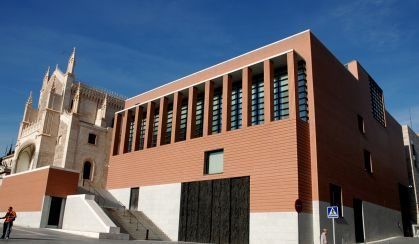

 The problem with the cloister, in my view, is that it is now a dead space, condemned to remain so eternally -or at least for as long as the Prado's extension exists-. 

It is in a room, under a roof, and protected from the elements by windows. The thing is, it stands at the top of the cube, as if suspended in midair. This is not how it was originally. But it is how it exists now. 

A museum piece which is being preserved because of the beauty of the architectural ensemble, but which is actually designed to be used, like any cloister anywhere else in Europe.

On my way home, I, as I normally do, took some photographs of the buildings surrounding me, and I began my internal dialogue with the usual thought: "How would he like this?" "Would he like this building? That one?" and I begin to imagine my telling him the story of this square, that palace, this museum, that street, all the time wondering what an American would make of an old city such as Madrid. 

Of its curving, uphill streets, of churches built on 70º slopes which face only buildings in front, and which have hardly any visual perspective. 

Of Renaissance palaces turned into hotels, and convents stuck in the middle of a commercial street, with all their treasures inside. 

Of those buildings in Madrid which are Art Deco, or mimick the best that 1920s new York and 1880s Paris had to offer because for a while, being modern meant being French, and then it meant being American.  

And  at the time, unfortunately, no one in Spain knew how to be modern by just being Spanish. I sometimes wonder if this has changed.

I ask myself these questions because I sometime see American tourists wandering in Madrid, looking strangely at the architecture, at the life that goes on inside bars, cafes, galleries, stores, boutiques, and at how it hardly resembles life back in the US. 

Yes, Madrid has malls and shopping centers, but they tend to be located on the periphery, not the center of town. 

And, Spain being Spain, one has to allow for local flavor. But (not my friend's case), most Americans know little of local flavor. 

Unfortunately, they think the world is a version of the US. And it isn't. So when I see them, I'm wondering about what they might make of it all. 

Of the old façades, the tree lined boulevards, which house tacky post war buildings and XIX aristocratic homes side by side, the massive structures built in a space too small to hold them, but which obviously was all they could do 200 years ago. 

And I imagine me acting as tour guide and historian. 

As I left Moneo's cube, I saw a couple of Korean tourists taking a photograph of the Los Jerónimo's church from below. It stood majestically against a cloudy winter sky. 


I wanted to say something. I wanted them to know that this was no ordinary church. 

That before Madrid's cathedral was finished only 6 years ago, this Gothic church had been where most of Spain's Royal weddings of the XIX century took place. 

That next to it stood the Royal Academy of the Spanish Language, itself part of the long lost Palace of El Buen Retiro. 

As I crossed the Prado Boulevard, across Neptune's Fountain, and with the Ritz behind me, I could make out the Spanish Parliament. 

Also built on a hill. I mused on the fact that it, and the Prado, are but a stone throw away from each other. And I wondered if the different sizes of the buildings meant something within the Spanish psyche. 

Did it mean that people in Spain value art over politics?

I would love to think so. But I am not convinced that any one country on Earth does this.

And these are the things I thought about today, when I went for a walk in old Madrid.

Tuesday, January 18, 2011

New Year, New Language

AOG, Madrid

Last year I decided I wanted to change my life, again. For the better. Again. 

Well, thus far my plans have gone on the back seat due to different circumstances, but they are not entirely parked. No.

I have decided to, at least for the time being, study a foreign language. On my last birthday, when I had decided to go down a new career route, my amazing partner offered to bankroll my French classes. Unfortunately, due to reasons beyond my control, I didn't quite find the right French class. There is a lot of choice here in Madrid, but for one thing or another, I never settled on anything. Or rather, I did find the right class, but I had to exhaust all possibilities. Then Christmas came round, the year ended, I was abroad, &c. 

So, now that I'm back, I've decided to enroll where I had intended to enroll all along, at the Alliance Française. Madame Mère is very happy with this choice too. 
Funnily enough, French classes do not start until today, even though the year 2011 started 18 days ago. 

Chinese

Last week, by the by, a friend of mine informed me that he was going to Chinese classes at Madrid's 'La Tabacalera'. 

What is this 'Tabacalera'? It is a sort of social group which has taken over a disused tobacco company from the XIX century in Southern Madrid and is squatting the premises, which are gigantic. 

As is often the case in Spain with squatters, so as to gain public favor, whenever they take over a disused or abandoned building, they very quickly turn it into a social/artistic center, and they (whomever they may be) have done so here too. 

I went with my friend, and was surprised (though perhaps I should not have been) at the amount of people which showed up at the venue for Chinese classes. 

Yes, I forgot to mention that the classes are free. Part of the whole social thing. I wouldn't understand.

So there I was, with another 60 people, about half of them standing, listening to the lovely Teresa teach us some Chinese. 

This she had to do in spite of the fact that some people, this Brazilian guy in particular, could not keep their mouth shut for more than a minute. He behaved as though this were a private class. 

Yes, he is one of those people who call attention to themselves at all times. 

Just like me, but without the sophisticated and subliminal tactics I use. Like keeping quiet, and nodding to appear more intelligent and savvy.

But Brazilianness was not alone. There was another guy, he of the 24 Hour-a-day-gay brigade, who was sitting at Teresa's hip level, and, towards the end of the class, kept pestering her to show us some Chinese writing. 

So she did, a couple of words. 

I can't do the pictographs here, but I was amazed to learn that "Rest" is drawn with the symbol for man and tree, and "Family" (and we all LOVED this one), is expressed by drawing a roof and a pig. 

Gotta love Chinese just for things like that!

All in all, Teresa's class served to take away a lot of the fear and apprehension I had surrounding Mandarin Chinese, the most widely spoken language on the planet. 

Tabacalera

When the class was over, I went for a wander around the Tabacalera, and found it to be quite interesting. 

There was a hall were people were dancing 1940s Big Band and Swing, a room where there was a Salsa class in full swing, a space where and 'Art Film' was being shown. 
 There even was a sort of Spiritual Room for Black People. No, I kid you not. There was such a thing. 

Needless to say, in Spain there is a small immigrant African community (distinct from any Hispanic Black people from the Americas or Equatorial Guinea, where, as you know, they speak Spanish since it is an ex Spanish colony), where you had to be Black to enter. No, don't ask. I am not Black so I have no clue what that is about. 

Perhaps it is about giving African immigrants a space of their own in a society which won't allow them much space.

I respected the space, and moved on to inspect the rest of the grounds, like the backyard, where I stayed for a very short while before the pong of Mary J. Wanna invaded my nostrils. There was also a slight air of danger about the place. 

They also had art pieces all over the place. Graffiti, drawings, collages. In short, they really push the art aspect, which I have to say I really like.

Not, perhaps, Gallery art, more urban and free, but art just the same.

 Squatters in Spain (known as 'Okupas' -the use of the letter "K" is to give them a certain outlaw Basque and anarchist flair; yes marketing is everywhere), much like squatters elsewhere on Earth, tend to be very friendly people until they loose it and turn aggressive. Much like non-squatters really. 

Except that they do tend to sell you that love the  Earth and your fellow man tree-hugging philosophy. 

Which is fine by me, and I agree with it, but I've never understood why it has to come with dreadlocks, drugs, and general bad body hygiene. But who am I to judge? 

They are happy, mostly harmless, and they are going to teach me Chinese, once a week, for an hour, for free. And all I have to do is survive the premises. 

I think I can handle it.

Thursday, January 13, 2011

Lost & Found


AOG, Madrid

This is the first post of January. I've been thinking about it for a long while but, frankly, I have been busy with "stuff" and I figured I just had to get the blog started somehow so as not to do what I did last year which was to leave it alone for months on end. So here goes.

So, what do I have to say for myself on this fine morning?
Well, if I may recap the past 13 days, the year ended in a more boring way than 2009 and at the end of it all, over the holiday season I  realized I'd found some things, and lost some others. 

Some, if you like, I found for a second time, since they had been, if not lost, then certainly misplaced, long ago. 

To celebrate the end of 2010, my partner and I went to the same Bar in Soho we did last year, with two friends of ours who also met with us on that occasion. 

Unfortunately, this time around the premises were was a bore-fest of almost epic proportions.

Why? Perhaps the economic climate had something to do with it. I don't know. But we were all a bit disappointed by the events. Something got lost in the past 364 days inside that place. 

The culmination of the night last year had been the broadcasting on television of the events down by the Thames -Big Ben, fireworks-, as well as the broadcasting of the celebrations around the rest of the planet up to that point. But this year, the bar in question decided to keep the TV off throughout. We all thought they would turn it on closer to the hour of midnight. But nothing. At midnight, all they did was play the Big Ben recording and some music. Anticlimax does not even begin to cover it. We felt like we'd been cheated somehow. I don't think we'll be going there again next year. 

Eventually we went home around 2:30 AM, and, on the first of January 2011 we went to the movies.

I have to say that the only other time I remember going to the movies on January 1st, was back in 1980. And it was nice to remember this. A memory I got back, and for which I am grateful.

We -my family and I- were living in Mexico City at the time, and I still remember that evening.
My mother, my sister and I left home in the evening; it was cold and dark outside, and we took a cab to the movie theater at the Plaza Universidad shopping center. I remember this because we always went there, the first shopping experience of my life. 

The first time I saw that famous Farrah Fawcett poster I was there. 

And my first Levi's and Lee ads, those with the feet and the sand, I was there. 


It was there where I saw my first ever copy of my favorite  late childhood/early teenagehood magazine: Vampirella. 

But back to films. The movie in question? 

Star Wars: The Empire Strikes Back.  It was a movie I could not wait to see.

The next installment of the Spielberg saga, Return of the Jedi, we would watch in Houston, Texas, roughly three years later. 

I remember thinking how exciting it was that the movie theater would be open on such a day, and of how grown up I felt for leaving home on a public holiday. 

And I was over the moon that this movie was out. I think the Star Wars saga is one of the first, if not the first, movie I was anxious to see as a child. There was something about them that mesmerized me back then. 

I don't know quite what it was, perhaps an early form of infantile escapism? I don't know for sure. But I do know that something went on in my psyche back then which, to a large degree, is still with me now.

Childhood was slowly coming to an end, and a new and exciting period of my life was beginning. But, of course, at the time, I knew nothing of this.We never do, do we?

Fast Forward to 2011. My partner and I also decided on a Sci-Fi saga, but of a different caliber: Tron Legacy.


I have to say, the movie is visually spectacular., much like the original was at the time, yes. But the plot is a bit of a turnip, and I can't really say what the movie is about. 

But, of course, the Special FX are amazing and you can watch the movie and listen to the soundtrack on your iPod and not worry about missing the plot. 

The other movie we watched over the holidays was the Spanish animated film Chico & Rita


It was drawn by Javier Mariscal, one of Spain's top designers (and responsible for Barcelona's 1992 Olympic logo) and directed by the Spanish Oscar winning director, Fernando Trueba

We watched it in Spanish and my personal anecdote of the film is that, whilst listening to the dialogues, I thought to myself that they reminded me of the speech that some of the characters have in Pedro Juan Gutiérrez's novels, such as the King of Havana or Dirty Havana Trilogy.


Imagine my surprise when the movie credits roll and I read his name as the speech consultant on the dialogues! I must admit that Gutiérrez was one of my favorite authors of 2010 and I read both aforementioned novels this past year thanks to a work colleague who introduced him to me.

I was able to distinguish his literary speech style in a film and I was very happy with myself that afternoon and for a few days afterwards.  Certainly, watching the film has made me want to revisit Havana 10 years on.

Perhaps the only sad point of these past few days was the fact that I left one book on the plane. Something I've never done before.

It was a short book on the life and times of Emperor Augustus Caesar

I had only just begun to read it, having bought it two weeks before, and was hoping to finish it in a couple of days. 

Yesterday I went to the place where I bought it, a second-hand book store on Santa Catalina's Square, but they didn't have another copy. 

I am thinking about contacting the airport to see if it was turned in by the stewards on the plane. One never knows.

Friday, December 31, 2010

2010 recap

AOG, London

The year 2010 is over. What a year it has been. I think the older I get the easier it is to take the good with the bad. Perhaps because one eventually realizes that there is just nothing else to do! 

Maybe this is wisdom of some kind.

Although only 365 years long, I have to say that, for the most part, I can't really remember a lot of what went on this year. Perhaps I can think of the grand themes of the year.

It started in a very humanitarian way with a natural disaster in Haiti early on. Moving on to a historical (but only for the British and no one else) general election in the UK which gave the country its first coalition-Government since the 1940s and the Winter Olympics in Vancouver which completely passed me by.

Later, I can recall the up-and-coming post UK election quagmire regarding the state of British finance; rioting students in London, and....well....little else in that country.

As for the rest of the planet, there was the Chilean miners story, the (pretend) Coup in Ecuador, Cuba's ever growing spiral into the abyss whilst pretending that all is well closely resembles the same idea, although with a local flavor, in Venezuela.

North Korea attacking South Korea, the US shunning the EU a few times, the Spanish economy heading for disaster,  the odd political corruption scandal in Spain, the Nobel peace prize winner (from China) and the Nobel prize for Literature (from Peru, though the Spanish press treat Vargas Llosa as though he were domestic), turmoil in Africa and, again, in the Middle East (by this I mean that there is no progress in the Israeli-Palestinian conflict).

On a personal note, this year was eventful in many ways, and subdued in others. 

Job went well, colleagues at work were all nice, made some friends, discovered one enemy (odd, right?), tried to find a new career path but was derailed early on and until further notice, and went to Turkey.

A new baby came into my partner's family, and thus, somehow, into mine. I had a good year for my photographs though not so good for my short-story writing. 
Health wise, well, I could be better. I've read some good books, and some good short stories. I've become (finally) a fan of Gaga, even though her concert in Madrid left me a bit lukewarm. I'm just not her little monster. Nor her little freak.

And, finally, I got to visit the place where I was born and to where I'd never returned since, not even once. And it was an odd experience.

I end the year realizing that, perhaps, I am a little ahead that from where I was this time 2009. 

I think that, all in all, this is a good thing.

Tuesday, December 21, 2010

Lunar eclipse

AOG, Madrid

Today there was a full lunar eclipse happening out in space.

According to the BBC, it is the first time since 1638 that a lunar eclipse has fallen on the winter solstice, the shortest day of the year. Also the longest night. 

Link here to the story. There's even a video of it.  

I remember reading that ancient societies used to celebrate the solstices with great religious festivals. 

It is one of those things which I think we should still do, but we don't. I don't mean the religious aspect of it.

I don't think the sky is falling or that it presages some future calamity (though the Universe could prove me wrong!), nor do I think it is some sort of divine "happening". 

It is just a natural phenomenon which we were treated to today on the planet. One of the many things I often take no notice of. It has always been like this. My modern life has always taken place in an urban setting, with artificial light to ensure civility after dark, and running water and canned food. 

My contact with nature's forces has been minute, unless the force in question was of inhuman magnitude. Like an earthquake, or a comet, or a flooding etc.

I remember seeing the  Hale-Bopp comet back in 1997. What a spectacle that was. I recall seeing it at night and thinking that this great light was hurdling towards this planet at a great speed. 

Although a natural phenomenon, I remember thinking that it looked ominous enough to make me feel scared. It certainly looked alien. It took forever to disappear from the sky and it was with us for a very long time. 

So my point is this. In my life, all solstices have just come and gone. 

When I lived in London, since from mid-October onwards it gets dark at  around 4:30 PM, the shortest day of the year was an odd thing to witness or care about since all days were short and it was always dark. 

As for the Summer solstice, it was always greeted with the annual "See the druids at Stonehenge" piece on the news which no one took seriously. 

Unfortunately, the solstices have lost all meaning in our culture. They come and go and we, unless we are druids, don't take much notice. 
Here in Spain, the night of San Juan (St. John) is known as the longest day of the year, and the shortest night. Bonfires are held and you are meant to jump over them to have your wishes granted. I did this in 2008 with some friends and, like today's solstice, it was raining profusely. 

Of course, until two years ago, I didn't much care for St. John's night or for the Winter Solstice. 
But today I did. And I hope that in future I will take notice. 

A solstice doesn't really mean anything (no, I don't know why everything has to mean something, I'm Hermeneuticed out), but it is nice to mark the passage of time on the planet. 

To note that we have gone once around the Sun and that the weather will change. That we are a part of nature, even when we don't notice.

Wednesday, December 15, 2010

FACEBOOK, and other maps

AOG, Madrid


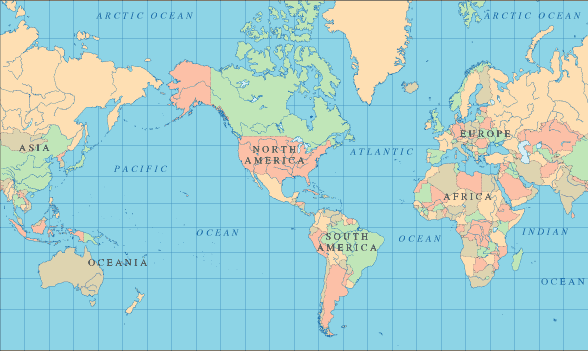
This is the new map of the world as influcenced by facebook. As you may gather from it, a lot of places have been left out. Here's a hi.res link to the facebook map.


Here's a link to they way facebook mapped the planet according to people's friends. 

So, what defines modernity? In facebook's case, about 500 million people and their pairs of friends.

The definition's landscape cannot escape the question, who is modern? 

But more importantly, who is not?

China isn't. Most of Africa is out. As is most of Brazil and the Islamic world.


And who is "modern"? 

No surprises there. The West. Europe, the US. Parts of Australasia. A thin line of Canada. Some Russian cities.

And the non-West? Japan, large bits of India.


Of course, if you think about it, the parts included are also the parts which hold most of our money, even though most of them don't get much air time on TV. 

At least not in the English-speaking world (so self-referencing!).

Is this map signifying something? 

In the XIX century, the British liked to redraw the political world and used to draw the British Isles rather engorged.

They were the dominant world power then.


I remember that in High School, maps always showed the US in the middle. Pride of place. 

It does not matter that it cuts Asia in half.


China does much the same.

 
Those of us who are not Chinese may find this interpretation of the planet as strange.

But it probably is just a question of adaptation. Why should they not be in the middle? They are the Middle Kingdom after all. 

I remember reading that the Emperor of China was upset when a Western General showed him a map of the planet. 

China -the Middle Kingdom because it was halfway between the heavens and the Earth- was not so big, when compared to others. 

But his main worry was that it was not in the middle. At the center. 

Rather, it was at the periphery of it all. 

How unlike today!

And Australia likes to show the world upside down (in a universe with no North or South).


Countries like to see themselves first. 

So narcissistic.

And at the top. 

North good. South, bad.

Monday, December 06, 2010

W I K I L E A K S

 AOG, Madrid

According to the Internet (guess whose name is buzzing and trending on most top 10 lists?), the arrest of Julian Assange, founder and director of Wikileaks, is imminent. 


 Apparently, he is wanted in Sweden in connection with rape and assault charges there. 

Now, I am no expert in undercover CIA ops, but it strikes me as odd that this guy would be guilty of said offenses. 

He may very well be, I don't know for a fact that he isn't, but isn't it 'convenient' that the US Government is these days trying to stop by all means a diplomatic fall-out with the rest of the planet courtesy of the salacious Australian? Link to the original story here.

As if that were not enough, even the website is under attack with some people calling Mr. Assange a "digital refugee": link to story here.


What amazes me most is the reactions of some politicians in the US who have declared that he should be put to death. Link to the story here

As we all know, when the American  Government (or any other foreign Government) does not want something to be known publicly, it does have a tendency to declare things like "National emergency", "Putting the lives of so and so at risk", "National interest concerns", etc etc. 

I'm sure that sometimes they are right, and sometimes they are not. 

But my question is this: is the American Government endowed with the divine power to decide who and what its electorate (and secondly the rest of the world) gets to know about its modus operandi

My take on it is that no, it just does not have that privilege. 

True, it certainly has the  resources to stop things from being known, but it, like the Papacy, cannot declare for itself the notion of Infallibility. Life just does not operate like that. Why? 

Because when faced with any Governmental pontification regarding the National interest, as defined by the US Government alone, a big fat "HELLO?" begins to take root on the mind of many people. 

Quickly followed by an "Excuse me?", and a no less irksome "Oh, really?" a la Saturday Night's Weekend Update.

If anything, the revelations of Wikileaks have shown that the US Government is probably the only Government who has an almost identical public and private discourse. 

Here in Spain, the revelations -as published by El País-, have only created a slight public outcry regarding the apparent Government intrusion into the Couso affair, whereby a Spanish cameraman was shot by US Forces in Irak, and the US has, it would seem, pressured Spain for this not to happen. 


Of course, Spanish authorities have always denied obstructing the course of Justice in the country. But the leaks are there...


The documents in question only show what the US Diplomatic Corps is meant to do. 

The Diplomatic Corps of any country. If surprises have arisen, it is often to do with National politics and the behavior of certain individuals, politicians and influential society figures in their respective countries towards their electorate, to whom in most cases, it has lied to , or hidden the truth from, concerning their relations with the US. 

In my opinion, the fault does not lie with the American Government. It is free to do whatever it wants, and to ask, request, or coerce other Governments to do their bidding. The problem lies with the other party, the one the Americans talk to. 


 The problem is not that the US wants you to do something. Well, of course, it would. It is a global power after all. The problem is when you go along with it. 

Is Mr. Assange as bad as Osama Bin Laden? 

No. 

He has not plotted to kill Americans or anyone else. He has merely publicised a lot of documents the US Government would rather nobody saw for at least 30-50 years. Some call that a crime. 

A crime only the US Government has decided it is one. But of course, as with all else in life, their take on the situation is completely subjective. 

It cannot be a crime simply because they say so.

Wednesday, December 01, 2010

World Aids Day

AOG, Madrid

Today is World Aids Day. How far we've come since that first glimpse into the illness back in 1983 when ABC's 20/20 program covered the disease for the first time.

I remember it well, I think it changed my life. 
I was living in Houston, Texas, at the time, and I was a young impressionable youth then of about 13. I remember watching the program and being mesmerised by it. 

I think I was too young to fully understand it, but old enough to know that, this AIDS thing was going to determine a lot in my life. For better and for worse.

I remember that soon after the program, my mother had some friends over, and they were talking about it. I particularly remember a lady, I forgot her name, who was very tall, and who was explaining to my family how shocked she was by what she had seen. 

"It can be passed on through the sweat in the palm of your hand", she said, as she stretched out her hand into the void to mimic a handshake. Whenever I think of Aids, I think of her and that handshake. And, of course, of the fact that she was terribly wrong.

I knew then that this definitely had something to do with me. 

Why? Well, because back in the 1980s (and unfortunately even today), the general consensus was/is that only gay people got Aids, and that it was a gay disease. It wasn't, it isn't, but the stigma is still there.

Since then, I've grown up and had AIDS surrounding my life constantly. 

I am gay, how could it not?

Soon enough, my mother, who hosted a radio show in Houston, began to investigate AIDS. 

A lot of people in the Hispanic community in the State of Texas were concerned with the disease. 

Many of them worked in hospitals, and they were, at first, being forced to clean up -without any sort of protection-, after patients. Many of them with AIDS. 

Of course, unfortunately, a few of them were infected. I remember my mother being very concerned with their health and promoting their protection. 

She invited doctors, investigators, lawyers, in short, a plethora of people to tackle the issue. It wasn't long before things changed. She helped, in her own way, to change this. Even Mexico's UNAM bought her radio shows. Such was the lack of information in the early days. I remember my sister and I helping her out. 

Gathering information, making phone calls, reading up on it on the press (no internet back then, remember?). I think that is where I got the journalism bug from. 

It was information with a purpose, and I was only too glad to help out. I think in a way, I was helping myself out too. By learning about protection.
London
Back in the year 1992 I was living in London. 

It was then that I met the first person with AIDS. I had just moved out from home and had hosted a "house warming" party at my flat in Pimlico. 

One of the guests, a friend of my first ever gay friend, Pierre, had invited another guy over. His name was Robert. He stayed after the party ended and helped me to clean up afterwards. 

He was a bit tipsy and we got to talking about many things. But, I will never forget this, the first thing he told me when we were alone, was that he had been diagnosed with being HIV + that same day. 

I was slightly in shock, since, until then, I had not met anyone who knowingly was positive. Knowingly. 

I didn't care that he was, since by now I had a pretty clear idea of how to protect myself. I tried to just be his friend. I think that is what I've always done when I meet people who are HIV+. This is because if I ever become infected, I think this is what I'd want from people. Just to treat me like any other human being.
Living in London, I must say that the pandemic hit me hard at times. I remember the first person I met who died of AIDS.

Him and his best friend came up to me once in Heaven, the night club. We became friends of sorts. They thought I was funny and, as they said "a new face in the scene". 

They liked me and I liked them, but we weren't buddies, just people who were friendly to each other and would speak to each other when they met. I don't know what word best describes that situation. 

Perhaps a lighter form of friendship, just above just an acquaintance? The first ever red ribbon I wore to commemorate the victims was given to me by them, the Lollies.

The years passed, and one day I noticed I saw one of them alone. I asked about the other one, and the reply shocked me. 

"Lolly died of AIDS a couple of months ago". 

His real name was not Lolly, but they called everyone Lolly.

Other too would follow in his journey. But many didn't.

Medicine, with its intense desire to end this disease, made things better for those who kept themselves alive. 

I write this with great pain, since many decided to let themselves go. I saw it. I cried for them. But it was their choice, and no one could do anything to stop them. 

Today, I am lucky enough to have a few friends who are still alive. Who care about themselves. Who survived. The cost I can't even imagine. Both at a personal level, and generational. People my age have suffered greatly, and their families and friends. 

I see that young people today are more cavalier with the disease. Just yesterday, whilst having a drink with some friends, a guy of 25 dismissed the whole thing with, "no one dies of AIDS anymore". 

I was shocked. He hasn't lived through it. Perhaps it is for the best that he didn't. It was no Pic - Nic.

But there are many more anecdotes I try to forget. 

Like the one about the guy who's partner was positive and he, out of love, became infected. 

Like the guy who felt he was missing out on the support of the gay community towards HIV positive people, and didn't stop until he became infected on purpose.

Like the guy, a close friend, who never volunteers his HIV status unless they ask. And they never, or almost never, ask.

Like the mother of two who committed suicide by mistake, in a drunken night, thinking she would have more help from the State if she was even more disabled.

I rather not go on, but it is obvious that this disease has taken its toll, mentally, on many of us.

My wish today, as every day, is that one day, before I depart this planet, World Aids Day is no longer held. That a cure, a vaccine, whatever, was found. 

And that all the suffering was not in vain.

That is my wish.

Friday, November 26, 2010

Thanksgiving Thoughts 2010

AOG, Barcelona

I think it is a wonderful thing about my life that I've been lucky enough to have lived in many different places. 

From everywhere I've lived, a little something has stuck. In the case of my childhood and youth, Thanksgiving, as is celebrated in the US, has stuck. 

Not just in my life, in my family's life too.

Yesterday I called my mother and sister to wish them a happy Thanksgiving. I contacted friends in the US to do the same. I wished everyone on Facebook a Happy St. Turkey' day. And I flew to Barcelona to be with my partner on this day.

Of course, to most people in Spain (sorry, make that Europe), the idea of Thanksgiving just means the old cliché about Pilgrims and Indians eating a turkey.

I can see their point. 

Cultural relativism is still alive and well.

For me, it had nothing to do with a Turkey. In fact, we had dinner at a Chinese restaurant. But, just before we started to eat, I pinky-held my partner's hands and gave thanks, in English.

Funny things about languages and memory. And feelings. I remember some things in one language, and others in another. And some in both.

Like my mobile number in Spain which I know only in Spanish, but my partner's number I know by heart only in English.

Similarly, yesterday I said thank  you in that language. Had I been forced to do it in Spanish, I would have had to practice before hand.

But the thing about this post, is that I had to think for a moment about the things I am grateful for. I think this year it was not a case of just going through the motions. I don't think it ever is. 

This is a link to what I wrote about Thanksgiving last year

Funny that both then and now I chose to mention the holiday.

Every year I've spent in the UK, I managed to gather a group of friends to celebrate Thanksgiving. And then I would meet my family to do much the same whenever possible. 

Of course for us, Thanksgiving day is more like Thanksgiving week. Just like birthdays are birthweeks and Christmas Day is a prolonged festivity.

It was not like this when we were kids, but modern life has this "feature" whereby you want to do one thing, and it ensures things develop in a different direction. 

So for us, what became important was not so much the day itself, more the celebration of an occasion which mean something important, never mind the date itself.

This weekend I am planning to have some friends over here in Barcelona and celebrate with them Thanksgiving.

So yesterday, I gave thanks for many things. For being able to have someone like my partner to have dinner with and celebrate the day; for having a loving family to whom wish a Happy Thanksgiving to; for being in good health (or at least alive!); for being happy (at least at that moment).

Yesterday, a good friend of mine posted this quote from the deceased Chilean writer Roberto Bolaño, on Facebook:

"I have been happy almost everyday of my life, at least for a little while, even in the most adverse circumstances".

I can't help but think about it ever since I read it. 

Isn't it true that we are happy, even for a short while, even on our worst days? I guess I never stopped to think about it. 

Even when I'm having a bad day. Or a bad week (can we say decade?), it is also true that, for short spurts of time, I am happy.

And for this too I gave thanks. For the ability to see things a little different.